Outdoor Kitchen Venting Requirements: Safety Standards & Design Guide
Everything North Atlanta homeowners need to know about proper ventilation for built-in grills, vent hoods, and outdoor cooking islands — from Georgia building codes to real-world installation best practices.
Before You Build: What Every Homeowner Should Know About Outdoor Kitchen Venting
An outdoor kitchen is one of the best investments you can make in a North Atlanta home. Families in Alpharetta, Milton, and Roswell are building them at record pace — and for good reason. But there's one critical detail that separates a safe, code-compliant outdoor kitchen from a potential disaster: proper ventilation.
We're not talking about comfort or convenience. We're talking about preventing gas pocket explosions inside enclosed islands, protecting your roofline from grease and heat damage, and meeting Georgia's residential building codes so your investment doesn't become a liability.
At Need Construction, we've designed and built outdoor kitchens across North Atlanta for years. We've also been called in to fix ventilation problems on kitchens built by contractors who cut corners. This guide covers the outdoor kitchen venting requirements we follow on every project — so you know exactly what to expect and what to demand from any builder.
Whether you're planning a simple built-in grill island or a full outdoor cooking suite with a pizza oven, smoker, and side burners, the venting principles are the same. Let's walk through them.
Why Outdoor Kitchen Ventilation is Non-Negotiable
Every built-in gas grill produces two things you can't see: combustion byproducts and unburned gas. In an open backyard, these dissipate harmlessly. But the moment you enclose a grill inside a stone or block island — or place it under a porch roof — you've created a space where dangerous gases can accumulate.
Gas Pocket Accumulation
Natural gas and propane behave differently when trapped. Natural gas rises and pools under countertop overhangs. Propane sinks and collects at the base of enclosed islands. Without vent panels, a single spark from the igniter can flash-ignite an invisible gas pocket. This is not a theoretical risk — it's the number one cause of outdoor kitchen fires nationwide.
Natural vs. Mechanical Venting
Natural convection venting uses passive island vent panels to let heat and gas escape on their own. Mechanical venting uses a powered vent hood with a fan to actively extract smoke, grease, and heat. Freestanding islands in open air can often rely on natural venting alone. But if your outdoor kitchen sits under any overhead structure — a covered porch, roof extension, or sunroom enclosure — you need mechanical venting. No exceptions.
North Atlanta Safety Standards
Fulton, Forsyth, Cherokee, and Cobb counties each enforce their own amendments to the International Residential Code. In practice, that means your outdoor kitchen must maintain specific clearances from combustible walls, have approved gas shutoff valves, and include proper venting — all verified during the permit inspection. We handle this process on every outdoor kitchen we build across Alpharetta, Milton, Roswell, Johns Creek, and Marietta.
Georgia Building Code Compliance
Georgia adopts NFPA 54 (the National Fuel Gas Code) as the baseline for all residential gas appliance installations, including outdoor grills. This covers gas line material and sizing, connection types, regulator placement, and minimum clearances. Local municipalities layer additional requirements on top — setback distances, maximum roofed coverage percentages, and drainage provisions. Building without a permit doesn't exempt you from these codes. It just means the problems surface during a home sale inspection instead.
Grill Vent Hoods vs. Island Vent Panels
Understanding which type of outdoor kitchen venting you need — and when you need both — is the difference between a safe installation and a code violation. Here's how we evaluate each project across our North Atlanta service area.
When a Mechanical Vent Hood is Required
Any time a grill is installed under a porch roof, covered patio, sunroom ceiling, or within 10 feet of a combustible overhang, a mechanical vent hood is required. This isn't a preference — it's code. The hood captures rising smoke, grease vapors, and heat before they contact overhead materials.
We see this most often in Alpharetta and Milton, where homeowners want outdoor kitchens integrated into their covered back porches. The vent hood becomes the centerpiece of the design, and we spec it before anything else gets planned.
Calculating Proper CFM
CFM — cubic feet per minute — measures how much air a vent hood moves. The formula is straightforward: take your grill's total BTU output, divide by 100, and that's your minimum CFM. A 60,000 BTU grill needs at least a 600 CFM hood. But outdoors, wind and open airflow reduce efficiency, so we typically spec 1.5x the calculated minimum.
A high-BTU grill paired with side burners and a pizza oven can push total output past 120,000 BTU. That demands a commercial-grade 1,200+ CFM hood with a properly sized duct run. Under-speccing the hood is like installing a bathroom exhaust fan over a restaurant range — it looks right but does nothing.
Island Vent Panel Placement
Every enclosed outdoor kitchen island needs vent panels — even if it also has an overhead vent hood. Panels allow trapped heat and gas inside the island cabinet to escape rather than building to dangerous concentrations. The rule: place panels on at least two opposite sides to create cross-ventilation, and add one panel for every 10 linear feet of cabinetry.
For natural gas hookups, panels are positioned low on the island. For propane, panels go high. Getting this backward is a common DIY mistake that defeats the purpose of venting entirely.
Non-Combustible Material Requirements
The entire outdoor kitchen island structure — framing, sheathing, and finish materials — must be non-combustible within the venting zone around the grill. That means steel stud framing (not wood), cement board sheathing, and finish materials like natural stone, porcelain tile, or stainless steel panels.
We use steel stud framing on 100% of our outdoor kitchen builds. Some builders still frame with pressure-treated lumber and claim it's "fire resistant." It's not. Treated lumber resists rot, not fire. This is one of the outdoor kitchen construction standards we never compromise on.
Quick CFM Reference for Common Grill Sizes
| Grill BTU Output | Minimum CFM | Recommended CFM (Outdoor) |
|---|---|---|
| 40,000 BTU | 400 CFM | 600 CFM |
| 60,000 BTU | 600 CFM | 900 CFM |
| 80,000 BTU | 800 CFM | 1,200 CFM |
| 120,000+ BTU | 1,200 CFM | 1,800+ CFM |
Venting Requirements for Specific Structures
Not all outdoor kitchens are created equal. A freestanding island on a concrete patio has very different venting needs than one built under a covered porch or integrated into a composite deck. Here's how we approach each scenario for homeowners across Roswell, Johns Creek, Cumming, and Canton.
Under Roofed Structures
Kitchens installed beneath GAF-certified roofing systems or any shingled porch roof face the highest venting requirements. Heat and grease vapor rising from a grill will degrade asphalt shingles, warp decking on upper-story balconies, and create fire hazards where soffits meet the roofline.
We require a minimum 36-inch clearance between the grill cooking surface and any combustible overhead material, plus a mechanical vent hood ducted to exhaust away from the roof structure — not just into the covered porch area. The hood must be rated for outdoor use with sealed motor housings.
Vertical vs. Horizontal Venting Paths
Vertical venting — straight up through or past the roofline — is always preferred because heat naturally rises. But many covered patios don't allow a vertical duct penetration. In those cases, we use horizontal venting: a duct run that exits through the side wall of the porch enclosure or terminates at the roofline edge.
Horizontal runs must slope upward at minimum 1/4 inch per foot to prevent grease pooling inside the ductwork. Every horizontal run also needs cleanout access points. Skip the cleanouts and you're scheduling a grease fire on a timer.
Clearing Combustible Soffits & Overhangs
Vinyl soffits, wood fascia boards, and composite trim are all combustible materials that require specific clearance distances from any outdoor cooking appliance. Georgia code follows the appliance manufacturer's listed clearances, which typically range from 24 to 48 inches depending on the grill model.
When clearances can't be met — common in tight porch configurations popular in Peachtree City and Newnan neighborhoods — we install non-combustible heat shields fabricated from sheet metal or cement board with an air gap behind. This brings the effective clearance into compliance without redesigning the entire porch.
Composite Deck Environments
Deckorators composite decking and similar products are not fireproof. They have higher ignition resistance than natural wood, but direct heat exposure from a grill will still melt, warp, and discolor composite boards. Every outdoor kitchen on a composite deck needs a non-combustible pad beneath the island — typically a steel pan with cement board infill.
We also add venting considerations specific to elevated decks: the open space beneath a raised deck acts as a natural draft channel, so island vent panels must account for wind-driven cross drafts that can pull gas sideways rather than letting it rise naturally. Proper panel orientation matters more on decks than on slab-grade installations.
Ready to Build a Safe, Code-Compliant Outdoor Kitchen?
Our team designs every outdoor kitchen to meet Georgia building codes and manufacturer clearance requirements — no shortcuts, no guesswork.
Our Outdoor Kitchen Work
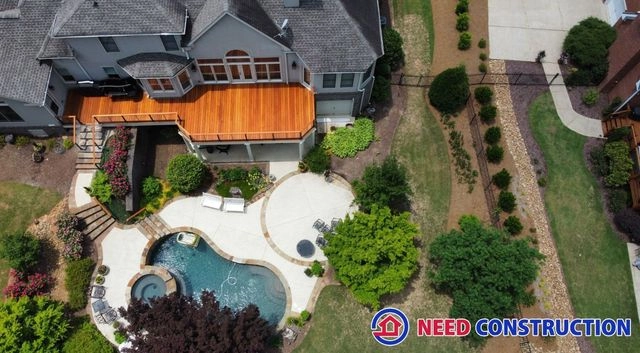
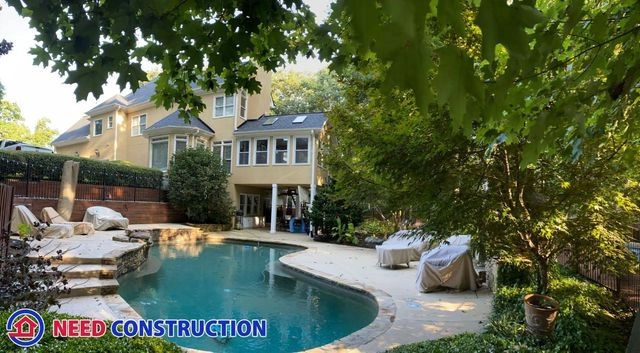
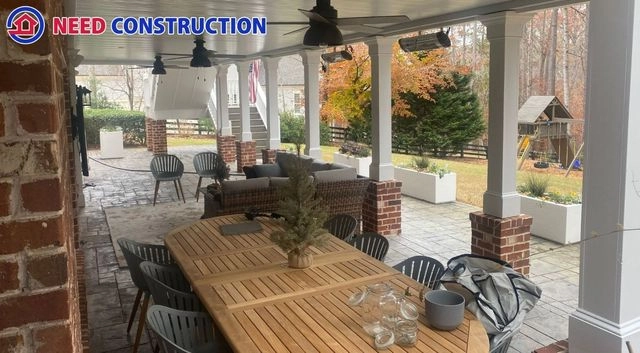
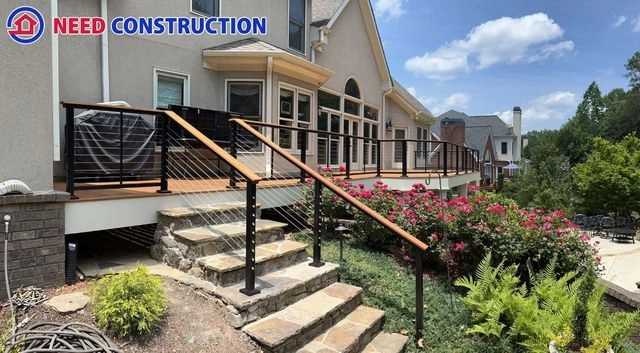
Built-in grills, vent hoods, and complete outdoor cooking spaces across North Atlanta — every one properly vented and code-compliant.
Outdoor Kitchen Venting Questions
Common questions from North Atlanta homeowners about ventilation requirements, safety codes, and proper installation.
Do I need a vent hood for an outdoor kitchen?
Yes — if your grill sits under any roof, ceiling, porch cover, or combustible overhang, a mechanical vent hood is required by code. Even freestanding outdoor kitchen islands benefit from a vent hood to pull smoke and grease away from your cooking area. We install vent hoods across Alpharetta, Roswell, and Milton homes and always recommend them for covered outdoor living spaces, which are extremely popular in North Atlanta.
How do you vent a built-in grill properly?
Built-in grills require island vent panels installed every 4 to 6 linear feet of cabinetry to allow trapped heat and gas to escape. For natural gas grills, vent panels are placed low on the island because natural gas is lighter than air and tends to pool at low points before rising. For LP (propane) grills, vents are placed high because propane is heavier than air and sinks. Getting this placement wrong is one of the most common mistakes we correct on outdoor kitchens throughout North Atlanta.
What are the safety codes for outdoor gas grills in Georgia?
Georgia outdoor kitchen construction must comply with NFPA 54, the National Fuel Gas Code, which covers gas line sizing, connection types, and clearances from combustible materials. Fulton County and surrounding North Atlanta municipalities also enforce local amendments regarding setback distances from property lines and maximum coverage under roofed structures. Our team pulls the permits and handles inspections so you don't have to navigate the code yourself.
Can I install an outdoor kitchen on a wood deck?
You can, but it requires careful engineering. A non-combustible thermal barrier — typically cement board or a steel heat shield — must be placed between the outdoor kitchen island and the wood decking. The deck itself needs structural reinforcement to support the weight of stone or block islands, countertops, and built-in appliances, which can exceed 2,000 pounds. We've built outdoor kitchens on Deckorators composite and traditional wood decks across Johns Creek and Cumming with proper load engineering every time.
How many vent panels does my outdoor island need?
The standard rule is a minimum of two vent panels positioned on opposite sides of the island to create cross-ventilation. For longer islands, add one vent panel for every 10 linear feet of cabinetry. Each panel should provide at least 20 square inches of free airflow area. Placement depends on your fuel type — natural gas vents go low, propane vents go high — and your island's orientation relative to prevailing wind patterns.
What happens if an outdoor kitchen isn't vented?
An unvented outdoor kitchen creates three serious hazards. First, gas can accumulate inside enclosed islands, creating pocket explosion risks when the grill ignites. Second, trapped heat accelerates wear on appliances, gas lines, and ignition systems, shortening their lifespan. Third, smoke and grease with no escape path stain porch ceilings, damage roofing materials, and create persistent odors. We've been called to remediate all three problems on improperly built outdoor kitchens in the Marietta and Roswell areas.
Is a vent hood required for an outdoor pizza oven?
It depends on the oven type and your installation. Wood-fired pizza ovens produce significantly more smoke than gas grills and typically require a chimney extension or dedicated flue routed above any overhead structure. Gas-fired pizza ovens under a covered patio need a mechanical vent hood rated for the oven's BTU output. Freestanding pizza ovens in open air generally don't require additional venting, though a hood still helps manage smoke during longer cook sessions.
Are outdoor vent hoods different from indoor ones?
Absolutely. Outdoor vent hoods are built with 304-grade stainless steel to withstand rain, humidity, and temperature swings that would corrode an indoor unit within a season. The motors are rated for higher CFM output — typically 1,200 CFM or more — because outdoor cooking deals with open air crosswinds that dilute extraction power. Outdoor hoods also feature sealed electrical components and UV-resistant finishes. Using an indoor hood outdoors voids the warranty and creates a safety hazard.
Still have questions?
We're here to help you find the answers.
What Our Customers Say
Homeowners across North Atlanta trust Need Construction for safe, expertly built outdoor kitchens.
"It's tough to find people you feel like you can trust not to try and get over on you. I spoke with Wes about work I needed to get done and was surprised at his level of honesty and professionalism. Putting that with the word of mouth on the quality of his work... and I wouldn't/won't hesitate to work with him on my next project."
MARSHALL NORTHINGTON
2026-03-02
"Wes is awesome! He helped rectify work done by a previous contractor and we would definitely recommend to anyone in the area!"
Austin Campbell
2026-02-01
"Great service ! Outstanding staff and was on time and efficient work was all around beautiful I have referred this company for many other jobs and plan to use them for many more projects"
Brianna Moore
2026-01-17
"We had a major project to be undertaken. Need construction to the rescue!! We had water damage to some of the framing on the home exterior and major deck demo and rebuild. They handled it all. I had some unique requests that I wanted installed on my deck. The DekDrain rain system along with the full composite Dekorators Summit boards and railing with a cocktail rail was our desire. We also had to have a concrete patio area below. Wes and his team made it all happen. The subframe was built with better materials that any other contractor had even offered and I was impressed with that alone. I have no doubt that hurricane force winds would have no effect on this fortress of a deck. Even the city inpectors were wowed by the build quality. The craftsmanship and finishing of the final product is top tier. They will take the time to make sure it's your dream come true."
Rodney Anderson
2026-01-16
"It was great working with Wes and the team at Need Construction. Wes was always in constant communication managing the project and made sure we were happy with the work during every part of the process. Very happy with the quality and workmanship of our new patio, couldn’t ask for much more!"
Lourdes Xavier Alfred Raj
2025-12-04
"Wes and his crew did a great job at a reasonable price rebuilding my shed roof after a tree feel onto it"
Paul Shaffer
2025-12-04
Continue Your Research
More resources for planning your outdoor living project in North Atlanta.
Deck Construction Cost Guide
Understand the real costs of building a deck in North Atlanta — materials, labor, and what drives the price up or down.
Read the guide →Modernizing 1970s Ranch Exteriors
Practical strategies for updating the curb appeal of ranch-style homes common throughout Roswell and Marietta.
Read the guide →Underdeck Drainage Benefits
How underdeck drainage systems create dry, usable space beneath elevated decks — perfect for outdoor kitchen placement.
Read the guide →Let's Design Your Outdoor Kitchen the Right Way
From vent hood selection to final inspection, Need Construction handles every detail. Call us or request a free design consultation.